
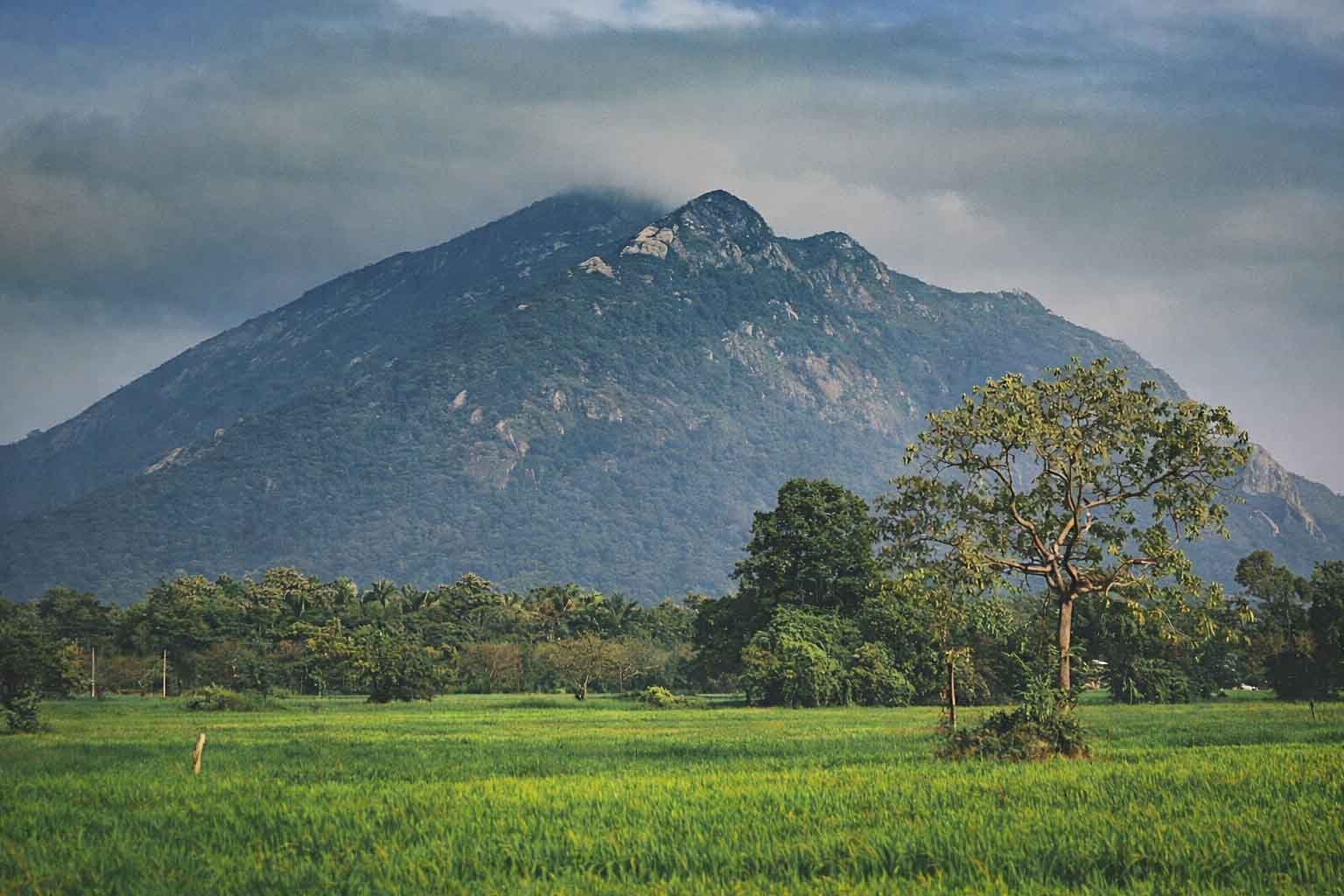
When people talk about Sri Lanka’s Cultural Triangle, names like Sigiriya, Anuradhapura, and Polonnaruwa dominate the conversation. But hidden deep within a strict nature reserve, just a short drive from Habarana, lies a mountain that feels like it belongs to another world. This is Ritigala.
Having trekked through its misty slopes myself, I can tell you that Ritigala isn’t just an archaeological site; it is a living mystery. It is a place where ancient engineering, spiritual silence, and legendary myths collide in a way that defies modern logic. If you are looking for the true “Island Flavors” of Sri Lankan history, this is where the journey begins.
1. The Legend of the Floating Mountain
The mystery of Ritigala begins with the ancient epic, the Ramayana. Legend has it that when the monkey-god Hanuman was carrying a fragment of the Himalayas (Sanjivani) to save the life of Rama’s brother, a piece of that mountain fell onto Sri Lanka. That piece, local elders believe, is Ritigala.
While many might dismiss this as mere mythology, a climb up the mountain suggests otherwise. While the surrounding plains of the North Central Province are often scorched by the tropical sun, the summit of Ritigala has its own micro-climate. It is often shrouded in mist and is home to rare flora and medicinal herbs that are usually only found in the high-altitude cloud forests of the hill country. Walking through these woods, you can’t help but wonder: is this truly a piece of the Himalayas resting in our dry zone?
2. The Architecture of Silence
Unlike the grand palaces of Sigiriya, the architecture of Ritigala is defined by what is missing. There are no ornate carvings of gods, no golden statues, and no grand stupas.
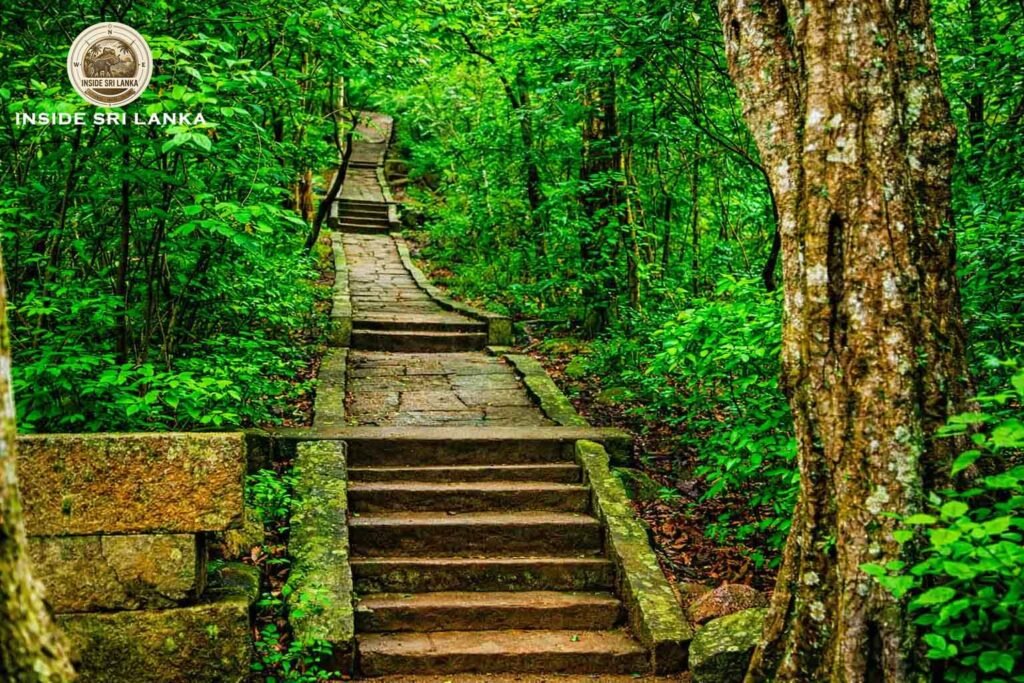
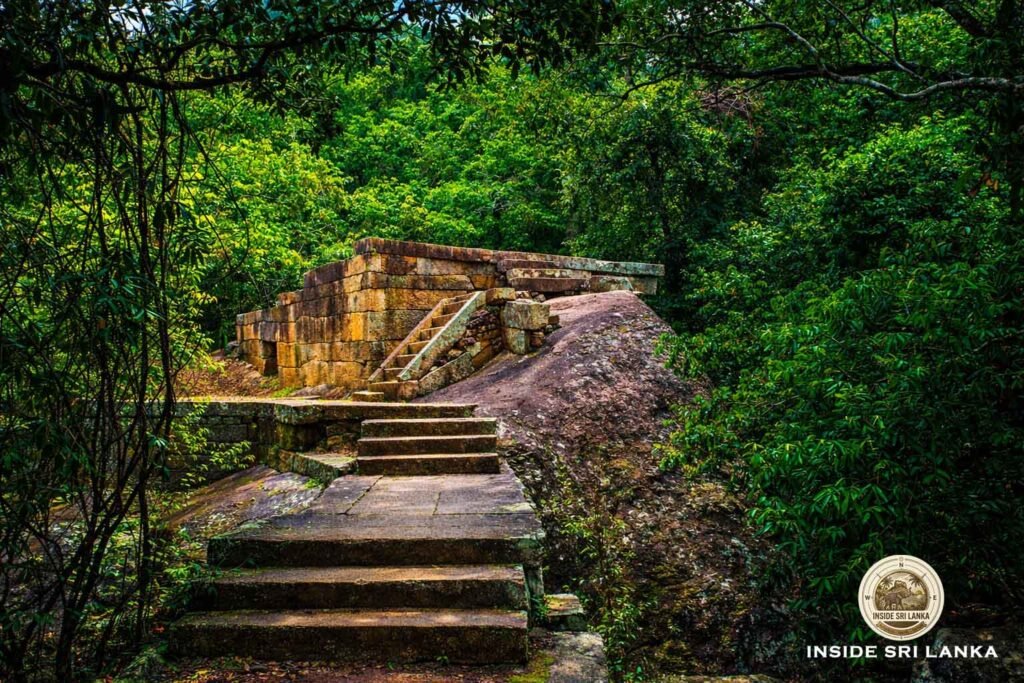
Ritigala was the home of the Pansukulika monks—a mysterious sect that lived in total seclusion and rejected all forms of luxury. Yet, their construction skills were superhuman. As I walked along the ancient stone paths, I was stunned by the precision of the stone-laying. These massive stone platforms (Padhanaghara) were built using a technique where stones are fitted together so perfectly that you cannot even slide a razor blade between them. Why did a group of monks who rejected the world build such massive, mathematically perfect structures? That remains one of Ritigala’s greatest secrets.
3. The Ancient Jungle Hospital
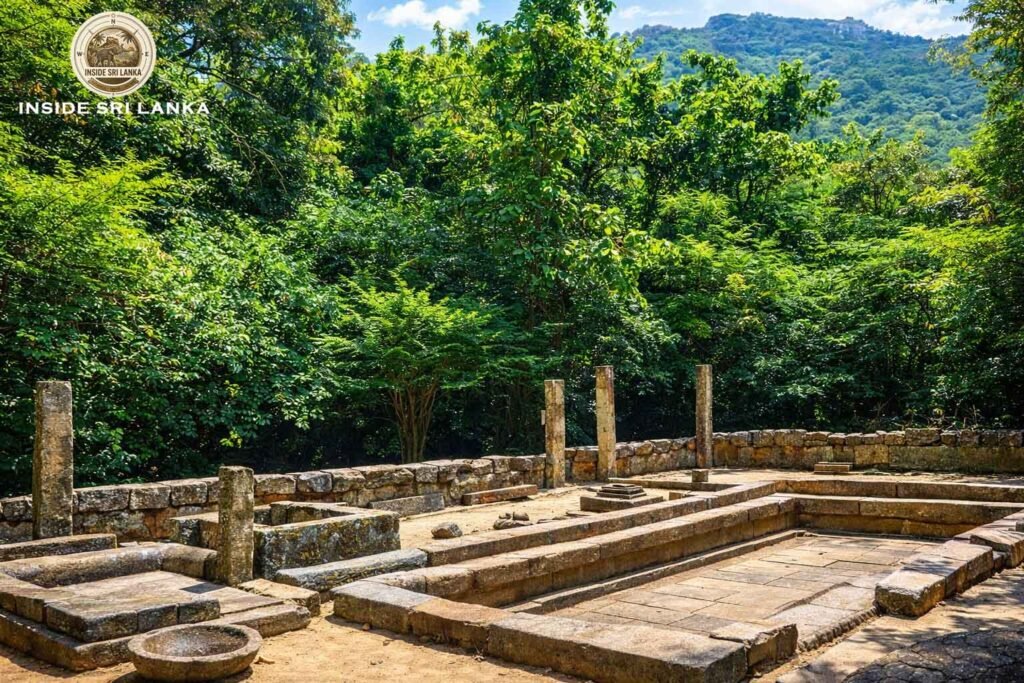
Ritigala wasn’t just a place for meditation; it was a world-renowned center for Ayurvedic healing nearly 2,000 years ago. Deep within the ruins, you can find elaborate stone baths and grinding stones used to prepare herbal medicines.
The way these ancient people managed water is an engineering marvel. Using the mountain’s natural springs, they created a series of stone-lined pools, including the massive Banda Pokuna, which served as a reservoir. This wasn’t just for drinking; it was part of a sophisticated “hydro-therapy” system where monks and visitors could heal their bodies and minds in the cool, filtered mountain water.
4. Shadows and Spirits of the Peak
Even today, local villagers are hesitant to enter certain parts of the forest after sunset. There are stories of mysterious lights on the summit and the presence of Ritigala Jayasena, a legendary yaka (spirit) commander who is said to guard the mountain.
Whether you believe in spirits or not, the atmosphere at Ritigala is undeniably heavy with energy. There is a specific kind of silence here—not the absence of sound, but a deep, resonant quiet that makes you feel small and humbled. It is a place where the barrier between the past and the present feels incredibly thin.
5. Essential Tips for Your Ritigala Trek
If you’re planning to visit this enigmatic mountain from your base in Habarana, keep these tips in mind:
- Timing is Key: Aim to arrive around 8:00 AM. The morning mist adds a layer of magic to the ruins that disappears once the sun is fully up.
- Respect the Jungle: Ritigala is a strict nature reserve. Do not leave any plastic or trash behind, and avoid touching the ancient stone structures.
- Wear Proper Shoes: You will be climbing stone steps that can be slippery due to moss and moisture.
- Stay Hydrated: While the mountain is cool, the trek can be physically demanding. Carry a bottle of water with you.
Conclusion: More Than Just Ruins
Ritigala is a testament to a time when humans lived in perfect harmony with nature. It doesn’t scream for your attention like other tourist attractions; it waits for you to listen.
As I left the mountain, watching its peaks disappear back into the clouds, I realized that Sri Lanka’s true “Ancient Secrets” aren’t found in the gold of the kings, but in the stone and silence of places like Ritigala. If you ever find yourself in the North Central plains, do not pass by this mountain. It has a story to tell you, if you are willing to hear it.